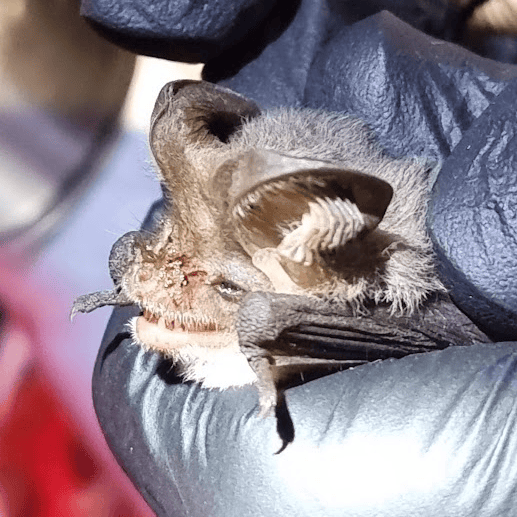

Overview
If you see a bat that might be injured, call BAT RESCUE WA 0426 134 908
Is there a bat in your building? – see FAQs from the Australasian Bat Society
Are there bats in Victoria Park and South Perth? The answer is yes. Are there bats in Jirdarup? Some.
Local bat enthusiast Ry Beaver is monitoring evidence of bats in Jirdarup. He has detected four species of microbats. The results of his surveys since 2023 are listed below. He led a workshop about our local bats on 9 August 2025 bringing out many bat enthusiasts in the area.
Bats are in fact the only native mammals that have been detected in this urban bushland in the last decade or so and had previously been overlooked in fauna surveys. A note in the old files of the Friends of Kensington Bushland indicated there were “bats near the bushland” in 2016.
Links to resources
- A 2025 paper on the use of bat boxes in Perth and Peel
- Gould’s Wattled Bat by Rewild Perth
- Colouring in sheet of a Gould’s Wattled Bat.
- WA Bat Network Facebook
- CCWA Bat Monitoring Program
- Bat Rescue Facebook
- Ry’s Wildlife Instagram Account – not just bats
- Ry’s Wildlife Website – not just bats
Results of bat surveys in jirdarup
| Date | Species | |||
| Long-eared bat (Nyctophilus sp. | Gould’s wattled bats (Chalinolobus gouldii) | South-western Freetail bats (Ozimops kitcheneri) | White-striped Freetail bat (Austronomus australis) | |
| June 2023 | Initial test over a couple of days | |||
| 1 | ||||
| November 2023 | 5 days: This was a particularly hot and dry period with daily temperatures over 35° compounded by a small fire in the bushland on day 3. | |||
| 6 | 2 | |||
| May 2024 | 10 days: The weather was mild, no rain, low moon. | |||
| 1 | 350 | 7 | 22 | |
| November 2024 | 10 days: There were a couple of rainy days in amongst the survey which likely would have reduced bat activity. | |||
| 1 | 120 | 17 | 1 | |
| May 2025 | 10 days: Unusual rain spell | |||
| 0 | 25 | 5 | 0 | |
| November 2025 | 10 days: Just after the full moon – nice Spring weather – not too hot. | |||
| 1 | 22 | 1 | 1 | |
| May 2026 | 10 days: After full moon – some sunny days with cooler evenings | |||
| 5 | 69 | 0 | 1 | |
Given the low call numbers, we hypothesise the bats were transiting over this portion of the bushland during the survey – not necessarily roosting or foraging.
The White-striped Freetail bat (Austronomus australis) is very common throughout Australia and has been recorded in nearby Carlisle. These bats can be heard by people with good hearing with their high pitched ‘zing, zing’ sound. They fly very fast, often quite high (over 50 metres) with a low frequency call (11-13kHz) for a bat that goes a long way.
Please send us any other observations of bats in and around Jirdarup and we will make sure they are reported to the Bat Monitoring Program being conducted by the Conservation Council of Western Australia.
BATS @MAY 2026
The bats are back after a low count in November 2025, with 75 recorded between 11 and 25 May 2026.
Ry recorded 5 Long-eared calls – 4 in one evening! Then 3 in the early morning within a minute – so guessing the same bat and then one in the evening and another the next day. They are harder to record as they are quieter but this is quite a few more than the single records from some of the previous surveys.
The White-striped call was in the same recording as a Gould’s. Ry also thinks there was a feeding call from a Gould’s wattled.
These recordings were after the full moon with some sunny days and cooler evenings, before the late May rain.
Bats @November 2025
There were 25 recordings in total from 9 to 18 November 2025, quite a lot lower than last years Spring survey but with lots more crickets and other ultrasonic noises. Some of the Gould’s wattled might be South-western free-tailed but were included with Gould’s as most likely. It was just after the full moon – nice Spring weather – not too hot.
- White-striped free-tailed – 1
- South-western free-tailed – 1
- Gould’s Wattled – 22
- Long-eared bat – 1
Bats @May 2025
Bat numbers in May 2024 were down on 2024.
There were 30 recordings in total from 16 to 26 May and Ry has estimated that this included:
- White-striped free-tailed – 0
- South-western free-tailed – 5
- Gould’s Wattled – 25
- Long-eared bat – 0
Bats @November 2024
In November 2024, Ry installed his detector in nearby Hillview Community Bushland and had over 4000 recordings. After initial excitement, analysis showed lots of ultrasonic noise at the site – possibly generated by the high voltage lines that border the reserve. Three (3) recordings that were bat – 1 White-striped free-tail & 2 calls from South-western free-tail.
From 18 November to 1 December, we revisited Jirdarup with a total of 9147 recordings which the software quickly scaled down to 2614 – the rest it deemed automatically noise. There were a couple of rainy days in amongst the survey which likely would have reduced bat activity.
We had 139 recordings of 4 species of bats
- White-striped free-tailed – 1
- South-western free-tailed – 17 (some may be Gould’s wattled as they can be similar)
- Gould’s Wattled – 120
- Long-eared bat – 1 (can’t tell species from call alone)
- and lots of insects making a racket!
Ry noted that one call from a Gould’s Wattled that looks like it has a feeding buzz which is a great sign – it was looking to munch something in the reserve!
Bats @March 2024
Results from a 10-day installation by Ry in May 2024 are exciting:
- 350 recordings of Gould’s wattled bats
- 22 recordings of White-striped free-tailed Bats
- 1 recording of Long eared bat
- 7 recordings of South-western free-tailed bats
The weather was mild, no rain, low moon.
Bats @May 2023
This was a particularly hot and dry period with daily temperatures over 35° compounded by a small fire in the bushland on day 3.
The initial results from November showed 5804 recordings of high frequency sounds creating much excitement. However, analysis showed that all but 120 were other noises – mostly crickets. Within those 120 calls, about 8 could have come from bats.
Ry was fairly confident he detected Gould’s wattled bat (Chalinolobus gouldii). This is one of the most common bats in Australia. After consulting with a fellow bat enthusiast, the other calls were confirmed to be from a South-western Freetail bat (Ozimops kitcheneri).
An earlier observation when it was cold and wet in June 2023 detected a long-eared bat (Nyctophilus sp.). For long-eared bats, the species cannot be identified from the calls alone – the bat must be seen. These bats have higher pitched calls, are very acrobatic flyers and feed in the canopy.
The graphic below is the “sound” of a long-eared bat.