
By Hugh Coppell, PhD student at Curtin University
Seed production is a fairly simple phrase for an astonishingly vast array of practices that seek to increase the supply of native seed for restoration. It is quite often featured in a dichotomy with seed collection, which refers to harvests from remnant populations, but the truth is more nuanced than that. The Florabank Guideline for Seed Production provides a definition that includes scales covering arboretum-like orchards to singular pots in a nursery and management practices that are as simple as irrigation of a remnant to complex large-scale industrial hydroponic systems. But what is the scale and management that you might need for the species you wish to grow for seed?
You might be interested to know that the use of native seed production areas has a long history in Western Australia. Joanna Seabrook and the Eastern Hills Branch of the Wildflower Society developed one of the earliest systems, aiming to revegetate a gravel pit. The insights from her book – Seeds of the Future: How to establish a native plant orchard and revolutionise revegetation – show us that a lot can be done in a small area given the right planning. Similar initiatives could be pursued in – or for – places like the Sandpit. So why don’t we see seed production areas everywhere?
Two familiar answers: lack of continuity of funding and difficulties anticipating future demand. Unsurprisingly, these issues remain present even today, despite the awareness of the importance of looking to seed production as a means of supplying restoration activities only growing since the publication of Seeds of the Future. Even as early as the late 1990s, it was clear that there would likely be an inability of collection from remnant populations alone to meet demand for Landcare projects. These findings were cemented through analysis of trends in the sector and by the experiences of practitioners, both undertaken at a time when offsets were only just starting to be mandated and the carbon market was finding its feet. The issue of inadequate seed supply for restoration activities has now achieved national recognition by the Federal government, with the new Implementation Plan for Australia’s Strategy for Nature 2024-2030 seeking to overcome “barriers such as seed supply” (page 8).
Of course there are complexities with establishing seed production areas. Careful consideration of the genetics of species to be used, risks of hybridisation between crops or with remnants, lack of knowledge of the horticulture of wild ecotypes and the consequences on seed quality to name a few. But this should not perturb us in pursuing seed production as a means to enable ecological restoration. Instead, consider it a new and exciting frontier in horticultural science that asks us to look at lesser-studied aspects of plant biology in the Western Australian context, such as phenological patters, fruit development and the effects of maternal conditions on subsequent generations.
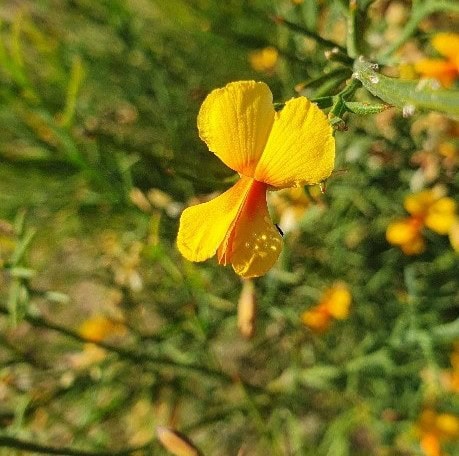
It is in this spirit that I hope to work within Jirdarup bushland to understand some of the basic biology of a pea species – Jacksonia sternbergiana – in order to optimise its management within a seed production setting. Hugh is very enthusiastic to keep the Friends informed of developments in his research, so keep an eye out for articles on seed production in future newsletter editions. If you’d like to get in touch to discuss seed production areas, or some of the potential research avenues that may enable their increased adoption, you can contact me at [email protected].