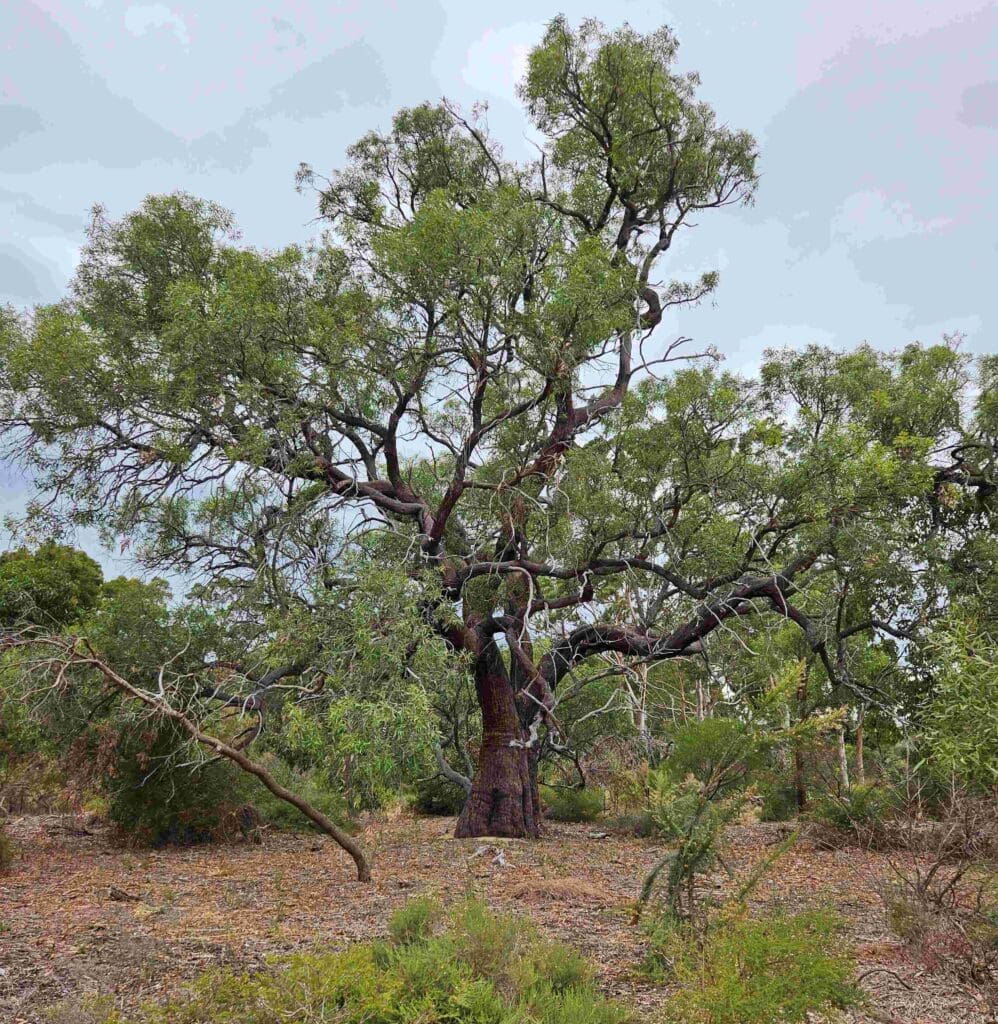

Local governments give the trees they are responsible for a number. This Eucalyptus todtiana is 112228 and lives in the Town of Victoria Park behind the Kensington PCYC on the edge of the Jirdarup Bushland. Curtin University students estimated it was 340 years old in 2025, that means it was a seedling around 1685 (see the previous page on trees for their methodology).
A lot has happened in Western Australia since 1685. If only this tree could tell us stories of what it has seen.
Long before it was named E todtiana after German artist Emil Todt the Noongar people called it Dwooda (we have revised this spelling from Dwutta based on advice from Kalyakoorl). It is also called Coastal Blackbutt and Pricklybark.
We think this tree is pretty special so it has its own email address if anyone wants to send it a message.
In November 2025, students from Millen Primary School wrote stories about this tree.
If you visit Old Todt, please stand back and admire it, and resist the urge to hug it. Its feeder roots are reasonably close to the surface. You might notice some small trees growing nearby. They are the result of seeds from Old Todt that were sprouted in 2025 and planted by Friends of Jirdarup Bushland in May 2026. We will keep an eye on them in the summer.
An arborist’s report on the health of the tree was undertaken in March 2026 (see below). Interestingly this report suggests the age lies somewhere between 80 and more than 600 years of age noting that this cannot be confirmed without invasive testing.
Read some of my emails
Hello, old friend. You’ve stood here since 1685, long before our roads and houses. You’ve seen generations come and go, and you’re still here — strong and silent. Thank you for being a living piece of history and hope.” As a counsellor, I’m often reminded how deeply nature supports our mental health — grounding us, slowing our thoughts, and restoring a sense of connection. Even a brief moment under an old tree like Dwutta can help us feel calmer and more present — a quiet reminder of resilience and continuity in a fast-changing world.
Dear 11128
Im in awe of your majestic and stately stance in the Jirdarup Bushland. How have you survived for so long and how can the people around the bushland now make sure you continue to live for much longer? I have another question. You must have provided homes to many creatures especially birds over 340 years many of whom would have built nests in your branches and many that you would have seen roaming around the bushland. Are there any birds you can think that nested in your branches and that were walking in the bushland 340 years ago and that aren’t there now?
Helen, Thank you for your email. About the birds, in the last 100 years I have seen lots of change. No more Emus, Bustards or Barking Owls but Kookaburras and far too many Rainbow Lorikeets have been visiting.
Significant Tree Register
In July 2025, we nominated it for the Town of Vic Park’s Significant Tree Register citing a 2004 Remnant Vegetation Report by Ecoscape for the Town of Victoria Park which described it as “an excellent specimen of Pricklybark (Eucalytpus todtiana) – possibly the best example of a Pricklybark Tree in the municipality.” (P31-32).
For a tree to be significant it must meet some criteria such as:
- aesthetic value
- old age
- rare species
- commemorative value
- associations with public figures
- cultural heritage
Following our nomination, 11228 was added to the Town’s Significant Tree register based on the observations in the 2004 Remnant Bushland Management Report.
Arborist’s report
Thanks to the Town of Victoria Park for permission to publish this report which was completed in accordance with the Town Policy 255: Tree Management that applies in relation to road reserves, parks and public spaces and assets managed by the Town. We note that the estimated age of the tree is very different from that provided by Curtin University. and of course no one wants it damaged just to settle on its age.
Date inspected: 18th of March 2026
Location: Southern corner of Lot 51 Anketell Street, Kensington
Tree species: Eucalyptus todtiana (Coastal Blackbutt)
Tree Observations
- This mature Eucalyptus todtiana (Coastal Blackbutt) is located within the southern corner of Lot 51 Anketell St, Kensington, forming part of a remnant vegetation community of high ecological significance (Figure 1).
- The tree has a height of approximately 12.8m, a canopy spread of 21.5m north/south and 19.5m east/west, and a trunk diameter of 141.5cm measured at 1.4 metres above ground level.
- The tree displays a broad spreading canopy, supported by multiple crown leaders, with the primary unions appearing structurally sound at the time of inspection (Figure 5).
- The tree is assessed to be in fair physiological health, with canopy thinning and significant deadwood evident, consistent with an advanced age class.
- The tree is considered to be in a late mature to post-veteran life stage, showing characteristics of senescence, including canopy retrenchment and reduced vigour.
- Historical aerial imagery confirms the presence of the tree as early as 1953, at which time it appeared well established. Based on this evidence, the tree is conservatively estimated to be in excess of 80 years of age, and likely to be greater than 100 years old (Figure 6).
- While anecdotal reports suggest significantly greater age (600+ years), this cannot be substantiated without invasive testing (e.g. increment coring or ring analysis) and therefore cannot be confirmed within the scope of this assessment.
Discussion/Conclusions
- This inspection found the Eucalyptus todtiana to be in fair health and poor structural condition, primarily due to the combined effects of age-related decline, termite activity, internal decay, and historical fire damage.
- The tree is considered to be in a post-veteran stage of development, with clear signs of senescence, including canopy thinning, deadwood accumulation, and epicormic regeneration.
- These characteristics are consistent with natural ageing processes for the species and are not indicative of abnormal or externally induced decline.
- While internal decay and termite activity are present, these are also common in older trees within natural bushland environments and contribute to habitat formation and ecological value.
- The tree is located away from primary pedestrian paths and infrastructure and therefore presents a low risk to persons and property in its current setting.
- The tree is considered a significant specimen within the southern corner of Lot 51 Anketell St, Kensington, both in terms of ecological function and local heritage value and is recognised within previous vegetation management documentation.
- In a typical urban setting, intervention such as deadwood removal, pest management, and soil improvement may be considered to extend the tree’s functional life. However, within a bushland management context, it is appropriate to allow natural processes to continue, unless risk thresholds are exceeded.
- This Eucalyptus todtiana (Coastal Blackbutt) is considered a significant specimen within the southern corner of Lot 51 Anketell St, Kensington. The tree contributes to the ecological function, habitat value, and visual character of the bushland precinct and represents an important element of the local natural heritage. The presence of features such as hollows, deadwood, and internal decay further enhances its ecological value, providing habitat opportunities for native fauna. As such, the tree should be managed with consideration to its environmental and cultural significance, with preference given to retention and minimal intervention in accordance with bushland management principles.
Recommendations
- Retention of the tree is recommended, with management aligned to a natural succession approach, consistent with bushland conservation principles.
- No immediate arboricultural intervention is required in relation to structural defects, given the low target risk environment.
- It is recommended that the native vine growth be selectively controlled or removed, to prevent canopy suppression and prolong the functional life of the tree.
- Ongoing periodic monitoring (every 2 years) is recommended to observe progression of decline and reassess risk as the tree continues through senescence.