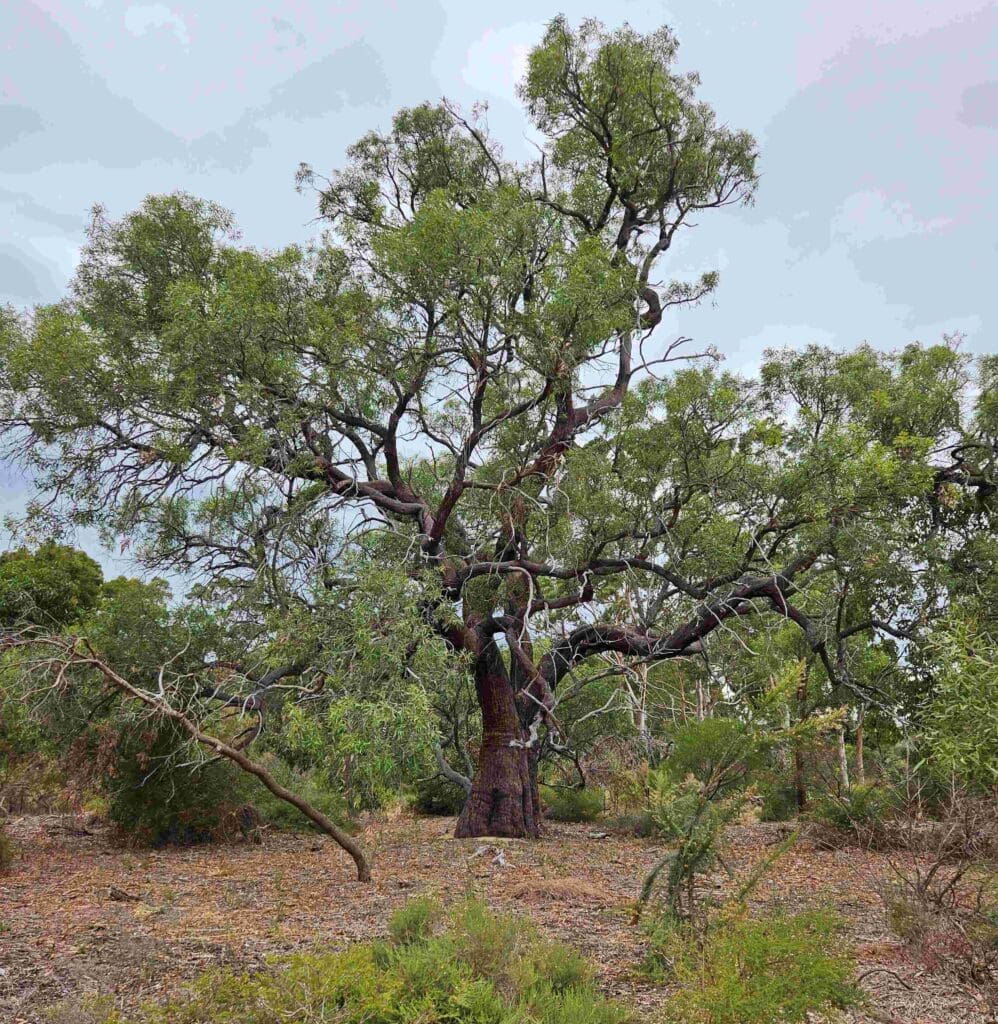

Photo: Pricklybark by Lesley Newport. This tree is behind the PCYC. It is 112228 on the Town’s register of trees. In 2025, Curtin University students estimated its age at around 340 years using the methodology outlined below.
Kensington Bushland
The Kensington Bushland is very interesting in that, in a very short distance, it has three main zones that grade from Jarrah/Banksia vegetation through a transition zone into a pricklybark/woolly bush shrubland.
Zone 1. In the Jarrah/Banksia community there are Jarrah (E. marginata), Firewood banksia (B. menziesii), Candlestick banksia (B. attenuata) and the Sheoak/Bulloak (Allocasurina fraseriana). Some Christmas Trees (Nuytsia floribunda) occur in this community as well.
Zone 2. Transition zone where Holly-leaved banksia (B. ilicifolia) and sedges occur on sometimes wet areas.
Zone 3. The soils to the south of the Jarrah bushland becomes deeper sand where the pricklybark (E. todtiana) thrive, alongside woolly bush (Adenanthos sp.) and some casuarinas (A. fraseriana and A. drummondii ).
This table lists the large trees that have been historically found in Kensington Bushland. Marri have been included because of their importance to the Cockatoo population. There are a small number around the perimeter, probably planted. It does not include other species that were planted as part of the regeneration of the George Street Reserve nor those in surrounding areas such as Harold Rossiter Park. Smaller trees that are sometimes described as tall shrubs are also excluded.
Unless otherwise stated, Whadjuk Noongar names are consistent with the Town’s interpretive signage.
| Scientific name | Common name | Whadjuk Noongar name |
| 1. Allocasuarina fraseriana | Western Sheoak | Kwel |
| 2. Banksia attenuata | Candlestick Banksia | Piara |
| 3. Banksia ilicifolia | Holly-leaved Banksia | Unknown |
| 4. Banksia menziesii | Firewood Banksia | Mungyt |
| 5. Corymbia calophylla | Marri | Kardan/Marib |
| 6. Eucalyptus marginata | Jarrah | Djarraly |
| 7. Eucalyptus todtiana | Pricklybark or Coastal Blackbutt | Dwooda |
| 8. Nuytsia floribunda | Western Australian Christmas tree | Moojar/Mundjah |
The attached photos may help amateurs identify these species in Jirdarup.
Trees across the Precinct
In addition to the trees in Kensington Bushland, there are over 500 trees in and around Jirdarup.
The 2018 Kensington Bushland Management Plan identified 5 trees in the Kent Street sandpit, 6 trees in George Street Reserve and 82 trees in Harold Rossiter Reserve as being suitable habitat for Black Cockatoos. Many of these are introduced species. Trees in remnant bushland are not counted in the Town’s tree register.
An analysis of all trees on the Intramaps site in these areas was undertaken by Robert Audcent identifying 501 trees across 38 species. Of those, 340 trees were on the Harold Rossiter Reserve. A copy of his spreadsheet is available from Friends on request.
Estimating the age of a tree
Jarrah and Marri
Estimating the age of mature trees is challenging. A 2014 paper by the then Department of Parks and Wildlife, provided a formula for estimating the ages of Jarrah and Marri, noting several caveats including the impact of watering on trees in parks and the increasing unreliability of the formula as trees age. Nonetheless, an estimation can be made using the following algorithm:
- Measure the circumference in centimetres of the tree at breast height, about 1.3m.
- Divide by 3.17
- Multiply the result by 2.35 and add 6.97.
The result is the approximate age of the tree in years.
Banksia
A Facebook post by Kings Park and Botanic Gardens on 10 June 2025 described how to estimate the age of a Banksia:
It’s commonly known that you can discover the age of a tree by counting the growth rings of the trunk. But for slow-growing trees, these rings are not always a reliable indicator! For plants like Candlestick Banksia (Banksia attenuata)—one of WA’s most iconic tree species—the secret lies in the size of its trunk.
By repeatedly measuring the trunk diameter, researchers can estimate growth rates and therefore the age of each tree, thanks to years of careful observation and fieldwork. It takes around 22 years for a trunk to reach just 5cm wide, and a Banksia with a 30cm trunk is estimated to be over 100 years old!