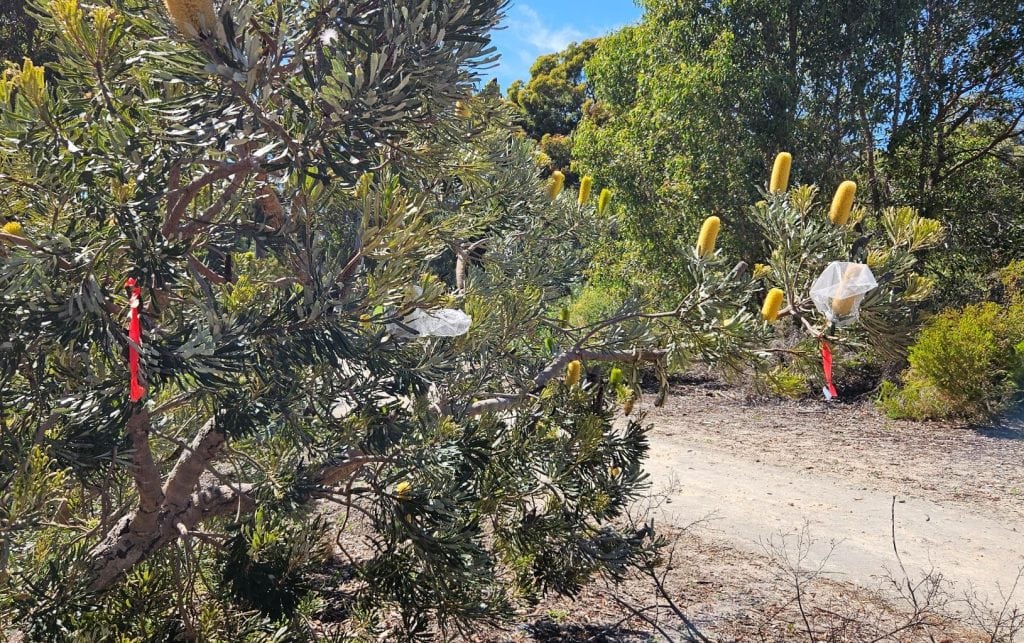

If you were ever wondering what the “bags and tags” on flowers in Jirdarup at the end of 2025 were about, or which animals call the bushland home, then our first event for 2026 was for you! Prof Paul Nevill, a molecular ecologist from Curtin University’s School of Molecular and Life Sciences, came to talk to us about eDNA, or environmental DNA. Paul’s students have been collecting eDNA samples from the flowers in Jirdarup.
On a lovely 8 March Sunday afternoon, 40 people from our community came to hear what he had to say and for many of us, this was our first introduction to eDNA. What a fascinating field that has developed only in the last decade!
Plants and animals are constantly shedding genetic material into the environment by dropping things such as cells or waste. For example, if a pollinator came to a flower in Jirdarup, they would likely leave behind a small amount of their DNA. This eDNA can be collected using a simple swab and then analysed to determine which species have interacted with that flower. It’s much faster and cheaper than many other monitoring methods, and can reveal traces of species that traditional monitoring might miss. But it can also be misleading – for example the kangaroo DNA found at Curtin University is more likely to come from a dog that ate kangaroo, rather than a live one hopping around!
eDNA samples can be taken from air, water or soil. It is used for:
- Monitoring diversity, in oceans, rivers, underground aquifers
- Detecting invasive species, like those that might come through ports
- Locating rare and endangered species
- Environmental assessment impact, restoration following mining for example
- Agricultural and forestry management, detecting soil pathogens and pollinators
- Detecting viruses in wastewater
Some of us especially loved his stories:
- The drive from Cottesloe to Cocklebiddy with filters on the outside of the car that had to be changed every 25 Kilometres. That makes for a very slow trip. And why did they detect wombat DNA between Norseman and Kalgoorlie? Roadkill on a truck?
- Explaining the vastness of WA to his audience in Slovenia. WA is about 3000Km from top to bottom – that is the distance from Bratislava to London and back – so an easy means of monitoring diversity in WA is really important.
- Driving around Dryandra with filters on the top of a 4-wheel drive to check out the wildlife.
We might even get into the nitty gritty of his research and read about the birds and the bees. Really important for the burgeoning avocado industry in Western Australia.
Paul has promised a paper on his findings in Jirdarup in a couple of months. We love that our bushland can contribute to science.
Thank you, Paul.
And thanks to local author HM Waugh for helping put this review together.