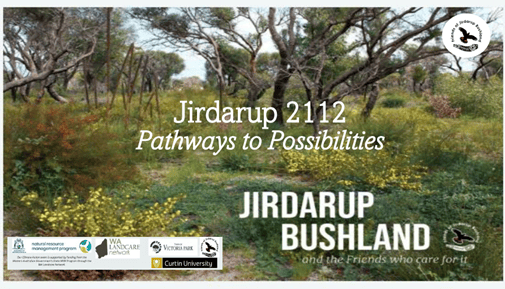

The Friends of Jirdarup Bushland, in partnership with the Town of Victoria Park and Curtin University School of Molecular & Life Sciences hosted a world café forum in November 2025 to consider the question: with Climate Change progressing how can we use our collective wisdom to ensure this Precinct continues to thrive to 2112 and beyond? This will mark 200 years after the area was set aside for community use.
Guest speakers Noongar Elder Professor Simon Forrest, Dr Linda Broadhurst and Dr Katinka Ruthrof set the scene focusing on the successful adaption of the Noongar people to environmental change over some 40,000 years; improving restoration outcomes using seed collection practices that maximise genetic diversity; and climate change impacts on forest health, such as drought and heat-induced forest die-off, and improving the success of forest restoration techniques and tree health, respectively.
Three key themes emerged.
Work better together
Our collective strengths are maximised when we work together: community organisations, volunteers with government, government with government, experts in different fields and work areas within organisations.
- The elements of the natural environment do not exist in isolation. Caring for Jirdarup requires the diverse and complementary expertise of ecologists, soil scientists, hydrologists, aborists, urban foresters and related disciplines as well as indigenous knowledge and community science.
- Stewardship of the natural environment requires as sense of ownership. Strategies that engage with the diversity in the community, such as First Nations people, young people, the multicultural community, schools and special interest groups need to be relevant and targeted. Governments can foster ownership by local Friends groups through their policies and practices.
- Biodiversity does not have borders. Acknowledging the work undertaken by the Town of Victoria Park to build green corridors through the Town and down to the Canning and Swan Rivers, there was a call for a stronger relationship also with the City of South Perth which borders the precinct on three sides. The planned re-development of the Department of Primary Industries and Regional Development (DPIRD) site on Baron-Hay Court is an increasingly important factor in the relationship with South Perth and the State Government.
- Strengthen links between the Town’s recently reviewed Urban Forest Strategy and the Jirdarup Bushland Management plan.
- Consider training for council staff and Friends to better engage with a diverse community.
Establish the evidence base
Research relevant to the conservation and restoration of the Jirdarup Precinct is happening in Universities, TAFEs, private businesses, community organisations and local governments. Jirdarup is well placed for postgraduate and undergraduate student research or projects. Even if that research is published, there is no systematic process or repository to keep track of what is happening for others to draw on. Key takeaways include:
- Rethink seed management and genetic diversity of species to build resilience for climate change while also drawing on local stock. Adapt, managing for the emerging conditions taking due consideration of historical conditions.
- Use modelling and simulations to predict what will happen as the climate changes.
- Reach out and contribute to postgraduate student research questions across all Universities and departments.
- Consider technical interventions to reduce heat stress such as dewatering/spearing and storm water reuse.
- Consider using apps for collaboration across multiple stakeholder groups or online games using bushland context and data.
- Consider strategies for community science engagement.
Strengthen community engagement
Community education and engagement as a means of creating awareness of the bushland and the importance of its conservation and restoration was a repeated theme. There was a strong sense that this community is not only the residents of Victoria Park but all the people who live around Jirdarup, many of whom live in South Perth.
- Create a sense of ownership and engagement not just passive awareness. Develop innovative practices to increase and diversify involvement
- Be exciting and innovative. Tell stories like the Traditional Owners do. Use a variety of storytelling methods, i.e. Storymaps, video, art exhibitions
- Education about the adverse impact of dogs and cats on the bushland and ways to tackle this through policy and practice
- Education for home gardeners around Jirdarup on the positive aspects of native gardens with local species to enhance biodiversity corridors, and the negative impacts of “weeds.” Continue to provide free “Jirdarup pack” to the local community
- Promote information about prevention and detection of pests and disease especially Dieback disease (Phytophthora cinnamomi) and Polyphagous Shot-Hole Borer
- Extend reach further into the community, participating in wider forums and connecting with diverse sectors and communities.
Processes
Many of those ideas were repeated at each table, others no less valid were confined to a single conversation. Some are visionary and others really practical. Some can possibly be implemented with a realignment of resources, others require investment in time if not actual dollars, and others might, for the present time at least, appear impractical. There is no expectation that all participants, or organising bodies, support all the ideas that were generated. That does not make the ideas invalid, nor does it mean the responsible bodies are opposed to change. It means the subject matter is complex.
Over the coming months, the Friends of Jirdarup Bushland will be in touch with participants to consider any actions that can be initiated in response to these conversations.
The event was organised by representatives from the Friends of Jirdarup Bushland, the Town of Victoria Park and Curtin University School of Molecular & Life Sciences. It was supported by a small grant from the WA Landcare Network. Organisers give their wholehearted thanks to Dee and the facilitators, Tracy Rainford, Stuart Leaver and Antonella Segre who donated their time and expertise to make this such a successful event.
The organising group thanks all participants for contributing their time and insights. The Friends of Jirdarup pay particular thanks to the Town of Victoria Park for hosting and catering for the day and to Dr Shane Turner from Curtin University for his advice on the agenda.
Contact us for a copy of the full report.