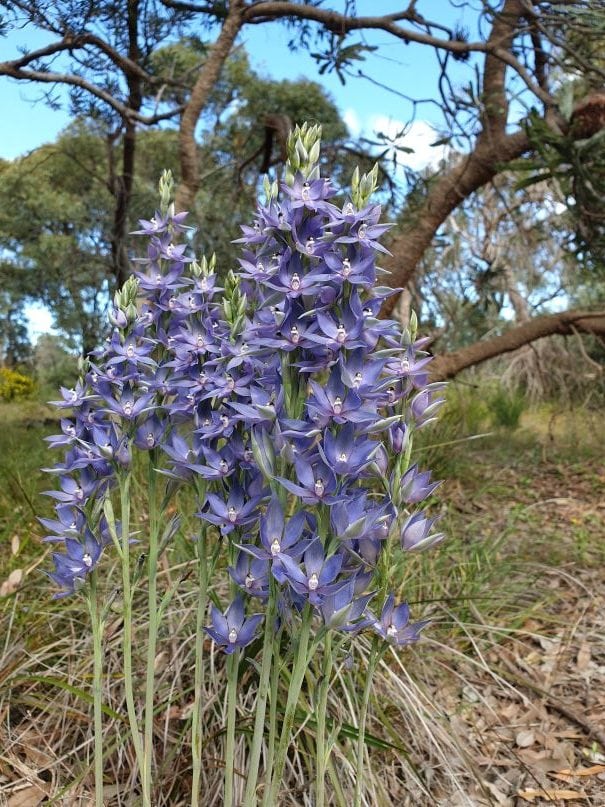

Sun orchids (Thelymitra) are a large genus of orchids with over 135 species, 48 of which are endemic to southwest of Western Australia. They can have up to 30 brightly coloured flowers on a single flower spike (inflorescence), with a wide range of colours including white, yellow, orange, mauve and blue. They are unusual among orchid species because they have a more typical flower structure, lacking the modified petal (labellum) found in most orchids.
Sun orchids are best seen on bright sunny days, opening after an hour or two of direct sunlight and closing when the sun passes. They can be readily seen from paths in the bushland. The colours range from blue to mauve and occasionally pink.
Two species are found in the Kensington Bushland, the scented sun orchid—Thelymitra macrophylla—and the shy sun orchid —Thelymitra graminea. The shy sun orchid is the smaller of the two with fewer flowers.
The scented sun orchid does not produce nectar. The column hood (or tip) is prominently yellow, which pollinators appear to mistake for the bright yellow pollen-producing anthers of other species such as purple flag (Patersonia occidentalis). When they mistake a sun orchid for another species, they inadvertently pollinate the orchid.
The generic name for orchids in the local Nyoongar language is djoobak. In August 2026, we had the privilege of being the first to publish the specific Nyoongar name for the sun orchid – walyamar. Local Nyoongar Elder Roni Gray Forrest recalls eating walyamar (blue sun orchid) as a child, growing up down south. She recalls “the bulb is crisp and sweet, it was very yummy. The walyamar has a blue flower, but you don’t eat it when it has the flower on it”.