
Photo and text by Georgina Wilson
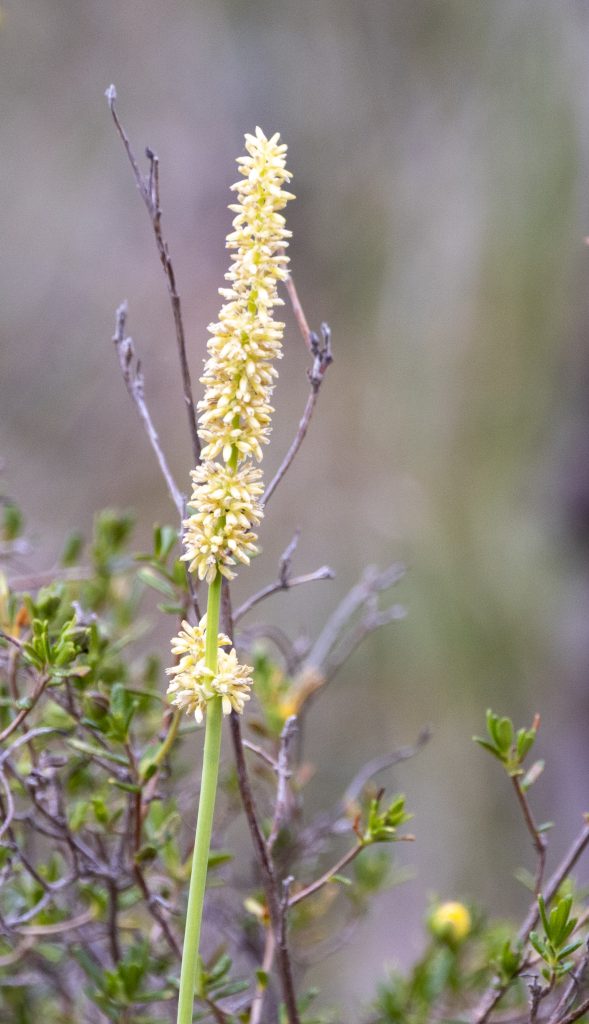
Sharp-eyed visitors to the Jirdarup Bushland between April and July may notice small greenish-yellow to purple flower spikes atop inconspicuous, reed-like leaves.
These are Lomandras, commonly known as mat-rushes because of their clumping growth habit.
Six different ones have been found in the bushland and the most obvious is Lomandra preissii or Preiss’s mat-rush. (The name commemorates German botanist Dr Johann Preiss, the first to collect plants systematically in Western Australia from 1838 to 1842.)
These perennial plants grow well in sandy soils and under Jarrah trees. They can be seen on both sides of the main path on the north-western side of Kensington Bushland before the George Street Reserve.
They are between 20 and 60 centimetres tall with purplish-blue to yellow-green flowers borne on spikes. In some places in Perth the L. preissii have been almost all cream or yellow, but Jirdarup has a much higher proportion of blue-purple.
Male and female flowers grow on separate plants and the male flowers have short stalks and six stamens. The females are stalkless with a prominent ovary. They are pollinated by beetles and native bees. Despite their grass-like appearance, Lomandra are classified as herbs.
About 50 Lomandra species have been found, all native to Australia. Some are fashionable with garden landscapers for their low maintenance requirements, erosion control and other features.
Lomandra have thick rhizomes that were chewed by Aboriginal people. Seed was pounded into flour or eaten whole and mixed with native honey. The strappy leaves were used to weave baskets for carrying food and tying things together. Their common name is Kitj, also the word for spear.
Lomandras have had various taxonomic placements by botanists over past decades. They are now in the family Asparagaceae.
(See our Makuru 2026 newsletter for more photos showing the variety of colours)