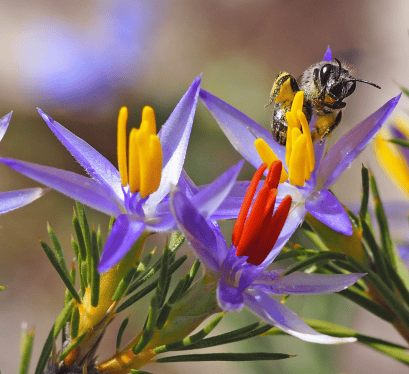

During 2026, Dr Kit Prendergast will be undertaking surveys of the native bee population – djilyara in the Noongar language – in the Kensington Bushland. As her results come through, they will be published here. She will do two surveys in the summer and two in the spring of 2026. Towards the end of the year, she will give a presentation on her research.
22 January 2026
Kit’s first survey was undertaken on a relatively hot morning in January. You can watch her report in her Instagram. from 22 January 2026. Kit became quite excited by mating swarms of the native bee Xanthesma brachycera. She also spotted Euhesma that specialise in Jacksonia. Euhesma has been documented in other parts of Perth but funding is lacking to fully describe the genus. In total, she found 234 bees in 2 hours.
21 February 2026
Kit returned for her second survey. Another relatively hot day. Numbers were down to 127 bees in total over 2 hours. Here are the highlights from her interim report.
Interim report
Over the two surveys, 21 species were recorded, 234 bees in January and 127 bees in February. Collected specimens (40 specimens) were pinned and labelled with location, GPS location, date of collection, collector, host plant, and given a unique identifier number. Specimens were collected under a DBCA Fauna Collection licence and will be deposited in the WA Museum Entomology Collection at the completion of the project (November 2026).
The bees
Remarkably, between the two surveys, separated by just one month, only a single species, Amegilla (Notomegilla) chlorocyanea – the most common bee in Perth – was recorded in both months. The most common species in January was Xanthesma (Xenohesma) brachycera (Colletidae: Euryglossinae). Tiny Euryglossinae e.g. Euryglossina hypochroma, were the most abundant group in February however they were flying many meters in the canopy meaning that they were unable to be collected and identified to species level. The most abundant collected species was Megachile (Rozenapis) ignita – a Fabaceae specialist that uses Banksia fuzz in its nests.
Jirdarup is clearly an important habitat and mating location for Xanthesma (Xenohesma) brachycera. This is a beautiful, relatively uncommon species. During the January survey at least five “leks” were observed. A lek is hundreds of males flying together in a cloud about 1 – 2 m above the ground, over flats of relatively bare, sandy soil. Such behaviours emphasise the value of open spaces and the natural condition of bushland, compared with the popularity of “pocket forests” comprising extremely dense patches of plants, mainly trees, that would prevent such mating behaviours. It is also likely the bees nest in this open ground. Despite looking for signs of nesting activity during the surveys, none were observed.
| Bee species | Jan-26 | Feb-26 | Sept 26 | Oct 26 | |
| 1 | Apis mellifera | 68 | |||
| 2 | Amegilla (Notomegilla) chlorocyanea | 6 | 2 | ||
| 3 | Apis mellifera | 53 | |||
| 4 | Coelioxys frogatti | 1 | |||
| 5 | Colletidae spp. | 110 | |||
| 6 | Colletidae spp. | 50 | |||
| 7 | Euhesma “jaffajacksonia” | 3 | |||
| 8 | Euryglossina (Euryglossina) argocephala | 1 | |||
| 9 | Euryglossina (Euryglossina) hypochroma | 1 | |||
| 10 | Euryglossina (Euryglossina) narifera | 1 | |||
| 11 | Euryglossina (Euryglossina) perpusilla | 1 | |||
| 12 | Euryglossina (Microdontura) mellea | 1 | |||
| 13 | Euryglossula fultoni | 11 | |||
| 14 | Hylaeus (Prosopisteron) “bicurvatus” | 2 | |||
| 15 | Hylaeus (Prosopisteron) “latifacies” | 2 | |||
| 16 | Hylaeus (Rhodohylaeus) proximus | 1 | |||
| 17 | Lipotriches flavoviridis | 3 | |||
| 18 | Megachile (Austrochile) tarltoni | 6 | |||
| 19 | Megachile (Eutricharaea) serricauda | 1 | |||
| 20 | Megachile (Hackeriapis) apicata | 3 | |||
| 21 | Megachile (Rozenapis) ignita | 12 | |||
| 22 | Megachile cf. tosticauda | 1 | |||
| 23 | Megachile leeuwinensis | 17 | |||
| 24 | Xanthesma (Xenohesma) brachycera | 4 | |||
| TOTAL | 234 | 127 |
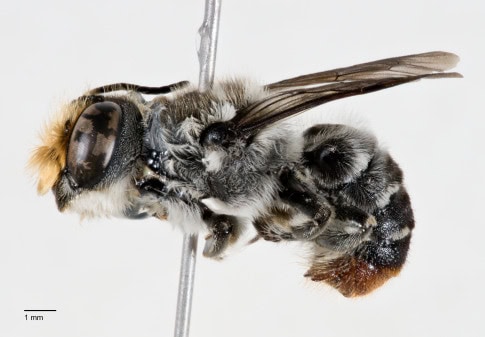
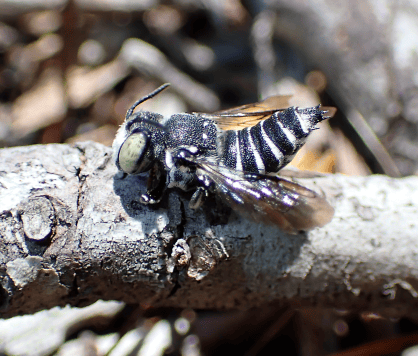
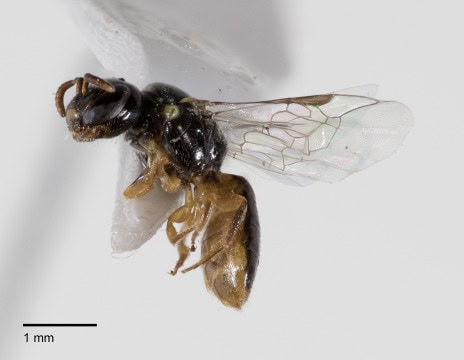
All photos (c) Dr Kit Prendergast (Bee Babette)
The flowers
In January seven plant species were visited, and six in February. In both months, Eucalyptus todtiana and Jacksonia furcellata hosted the greatest abundance and diversity of bees. Unfortunately, Apis mellifera also preferred Eucalyptus todtiana, which may result in competition. There greater abundance and diversity of bees in January compared to February can be attributed to the decrease in flowering of the major host plants – Eucalyptus totdiana, Jacksonia furcellata, and J. sternbergiana.
| Plant species | Jan-26 | Feb-26 | Sept 26 | Oct 26 |
| Banksia attenuata | 6 | |||
| Billardiera variifolia | 1 | |||
| Calytrix faseri | 2 | 4 | ||
| Eucalyptus todtiana | 189 | 101 | ||
| Jacksonia furcellata | 21 | 14 | ||
| Jacksonia sternbergiana | 4 | 4 | ||
| Melaleuca systena | 3 | |||
| Persoonia saccata | 5 | |||
| Scholtizia involucrata | 7 | |||
| TOTAL | 234 | 127 |
This project is made possible by a grant to the Friends of Jirdarup Bushland from Community Underwriting Insurance.